
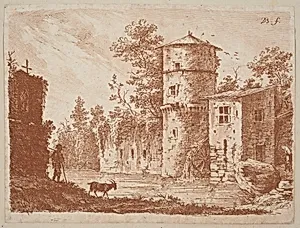
Ancient Tower at a Water Mill
Medium
etching and drypoint in sepia
Dimensions
sheet: 11.4 x 15 cm (4 1/2 x 5 7/8 in.) mount: 16.7 x 23 cm (6 9/16 x 9 1/16 in.)
Classification
Department
CG-E
Museum
National Gallery of Art, Washington, D.C.
Credit
Gift of the Estate of Leo Steinberg
Accession Number
2011.139.69
Rights
Public Domain
Art Historical Context
Jean-Jacques de Boissieu's *Ancient Tower at a Water Mill* (1759) is a delicate and drypoint in warm sepia ink, measuring just 11.4 x 15 cm on its sheet. This intimate print captures a picturesque rural scene, blending an weathered ancient tower with the humble mechanics of a water mill, evoking the charm of 18th-century French countryside. De Boissieu, a Lyon-born engraver (1736–1810), was renowned for his masterful prints that drew inspiration from 17th-century Dutch masters like Rembrandt, infusing landscapes with atmospheric depth and tactile detail. The technique shines here: etching creates precise lines through acid-etched plates, while drypoint's direct needle scratches produce velvety burrs for soft, expressive textures—like the mill's rushing water or the tower's crumbling stone. Printed in sepia, the work glows with a nostalgic warmth, heightening its romantic allure amid the Enlightenment's growing fascination with ruins and nature's quiet poetry. Housed in the National Gallery of Art's Prints department (gift of Leo Steinberg's estate), this piece exemplifies the era's shift toward intimate, original prints as affordable art for collectors, bridging Rococo elegance and emerging Romantic sensibilities. A gem for visitors seeking the subtle poetry of everyday history.
About the Artist
Jean-Jacques de Boissieu (French) · 1736 –1810
French, Lyons 1736–1810 Lyons