
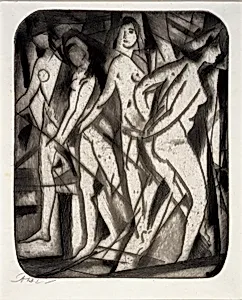
Andante
1916
Medium
Graphic Arts-Print
Classification
Graphic Arts-Print
Department
Smithsonian Collection
Museum
Smithsonian American Art Museum
Credit
Smithsonian American Art Museum, Museum purchase
Accession Number
1971.60
Rights
Public Domain
Tags
Art Historical Context
**Andante** (1916) by Arthur. Davies is a delicate graphic arts print housed in the Smithsonian American Art, acquired through museum purchase. Davies, a pivotal figure in 20th-century American art helped organize the groundbreaking Armory Show of 1913, which European modernism to the U.S. By 1916, his work had evolved from the gritty realism of the Ashcan School toward a more poetic, Symbolist-inspired style, often featuring ethereal nudes in harmonious, dreamlike settings. The title *Andante*—a musical term evoking a gentle, flowing tempo—hints at the artwork's lyrical rhythm and serene mood. As a print medium, *Andante* exemplifies Davies' mastery of graphic techniques, allowing for intricate lines and subtle tonal variations that capture soft contours and atmospheric depth. Nude figures, a recurring motif in his oeuvre, symbolize ideal beauty and nature's grace, reflecting the era's fascination with classical themes amid rapid industrialization. This piece underscores Davies' role in bridging traditional romanticism with modernist experimentation, making it a gem in the Smithsonian's collection of American prints. Visitors will appreciate how *Andante* invites contemplation of harmony in a turbulent time, just after World War I's onset, offering a timeless escape into artistic reverie.
About the Artist
Arthur B. Davies · 1862–1928
Arthur Bowen Davies (1862–1928) occupies one of the most paradoxical positions in American art history: a painter whose own canvases were lyrical, dreamlike, and rooted in the classical tradition, yet whose organizational energy and curatorial vision helped force American audiences into direct confrontation with the European avant-garde. Born on 26 September 1862 in Utica, New York, to English and...