
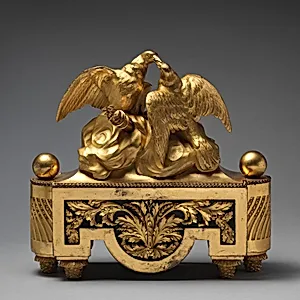
Andiron (feu or chenet) (one of a pair)
ca. 1780
Medium
Gilded bronze
Dimensions
9 3/4 × 10 1/2 × 4 1/2 in. (24.8 × 26.7 × 11.4 cm)
Classification
Metalwork-Gilt Bronze
Culture
French
Department
European Sculpture and Decorative Arts
Museum
Metropolitan Museum of Art, New York, NY
Credit
Bequest of Mrs. Charles Wrightsman, 2019
Accession Number
2019.283.82
Rights
Public Domain
Art Historical Context
This exquisite pair of andirons, crafted by the renowned French bronzier François Rémond around 1780, exemplifies the opulence of late Louis XVI decorative arts. Made of gilded bronze—a luxurious medium where a thin layer of gold is applied over bronze for a radiant finish—these feu (or chenets) served a practical yet elegant purpose: supporting firewood in grand fireplaces while elevating the room's aesthetic. Measuring about 10 inches tall, their compact form was designed for symmetry in opulent interiors of aristocratic homes or châteaux. Rémond, a master of Neoclassical metalwork, was celebrated for his intricate designs that blended classical motifs with refined French elegance during the final years of the Ancien Régime. These andirons likely featured ornate detailing—typical of his oeuvre—such as scrolling acanthus leaves or mythological figures, showcasing the era's emphasis on harmony and proportion inspired by ancient Rome and Greece. Gilding not only protected the bronze but symbolized wealth, making them coveted status symbols amid the lavish patronage of the French court. Now part of the Metropolitan Museum of Art's European Sculpture and Decorative Arts collection, thanks to the 2019 bequest of Mrs. Charles Wrightsman, this pair invites visitors to imagine the flickering glow of a Versailles hearth, bridging utility with artistic splendor.