
Andrew Jackson
Medium
Classification
Department
Smithsonian Collection
Museum
Smithsonian American Art Museum
Credit
National Portrait Gallery, Smithsonian Institution
Accession Number
NPG.87.41
Rights
Public Domain
Tags
Art Historical Context
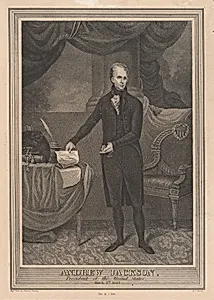
This striking 1829 print portrait of Andrew Jackson, created by engraver Francis Kearny (5–1837), the newly inaugurated seventh President of the United States at a pivotal moment in American history. Produced in the year Jackson took office, it reflects the era's fervor for the "people's president," a Tennessee lawyer, general, and hero of the Battle of New Orleans who also earned a Congressional Gold Medal for his Florida campaigns. As a print from the Smithsonian Art Museum's National Portrait Gallery collection, it exemplifies early 19th-century reproductive techniques, likely engraving, which allowed widespread dissemination of influential figures' likenesses to a democratic public hungry for visual icons. Kearny's composition employs classic portrait symbols of authority: Jackson is depicted with quill and documents on a table, books nearby, seated in a draped chair against a column—evoking neoclassical ideals of leadership and intellect. These elements underscore Jackson's transformation from frontier general to commander-in-chief, embodying the rising spirit of Jacksonian democracy. Far from elite oils, this affordable print democratized portraiture, making presidential imagery accessible and fueling national identity during a time of expansion and political realignment. A testament to art's role in shaping history, it invites us to ponder Jackson's enduring, complex legacy.