
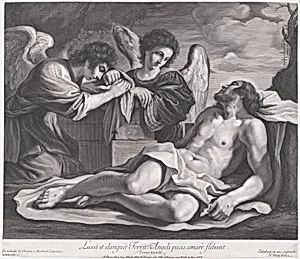
Angels Mourning over the Dead Christ
Medium
Etching
Dimensions
Mount: 15 15/16 × 21 in. (40.5 × 53.4 cm) Sheet: 15 3/8 × 17 11/16 in. (39 × 45 cm)
Classification
Prints
Department
Drawings and Prints
Museum
Metropolitan Museum of Art, New York, NY
Credit
Harris Brisbane Dick Fund, 1953
Accession Number
53.600.2323
Rights
Public Domain
Tags
Art Historical Context
This moving etching captures a poignant moment of grief, with angels tenderly surrounding the lifeless body of Christ. Created around 1690–1720 after a design by the Italian Baroque master Guercino (Giovanni Francesco Barbieri), the print was executed by Flemish and French engravers Theodor van Merlen II and Nicolas Pitau. Guercino’s signature style—characterized by dramatic emotion and tender humanity—translates powerfully into this reproductive medium, inviting viewers to share in the angels’ sorrow. Etchings like this played a vital role in the Baroque era, allowing devotional images to reach wide audiences beyond church walls. The medium’s fine lines and subtle shading beautifully convey the delicate wings, flowing drapery, and quiet anguish of the figures, emphasizing themes of sacrifice and redemption central to Christian art. Housed in the Metropolitan Museum of Art’s Department of Drawings and Prints, this work highlights how prints preserved and popularized the emotional intensity of Baroque painting for generations of worshippers and art lovers alike.
About the Artist
Guercino (Giovanni Francesco Barbieri)|Theodor van Merlen II|Nicolas Pitau · 1591–1666
Guercino — the nickname meaning "squint-eyed" — was born Giovanni Francesco Barbieri in Cento, near Ferrara, in 1591. Largely self-taught in his early years, he absorbed the dramatic chiaroscuro of Ludovico Carracci's work in Bologna and the naturalistic innovations spreading from Caravaggio's circle, forging from these influences a highly personal style of extraordinary expressive power. By his e...