
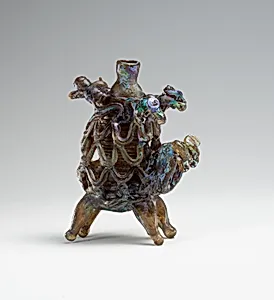
Animal Flask
Unknown Artist
late 7th–8th century
Medium
Glass, amber-colored; blown, applied decoration
Dimensions
H. 4 3/8 in. (11.1 cm) Gr. L. 3 1/4 in. (8.3 cm) Gr. Diam. 1 7/8 in. (4.7 cm)
Classification
Glass
Department
Islamic Art
Museum
Metropolitan Museum of Art, New York, NY
Credit
Gift of Mrs. Charles S. Payson, 1969
Accession Number
69.153
Rights
Public Domain
Tags
Art Historical Context
This charming *Animal Flask*, crafted by an unknown artist in the 7th–8th century, exemplifies the ingenuity of early Islamic glassmaking Fashioned from amber-colored glass using the blown technique with applied decoration, the flask stands just 4⅜ inches (11.1 cm) tall, with a graceful length of 3¼ inches (8.3 cm) and diameter of ⅞ inches (4.7 cm). Its whimsical animal form—likely evoking a creature in motion—transforms a functional vessel, possibly for perfumes or oils, into a delightful sculptural object. Housed in the Metropolitan Museum of Art's Department of Islamic Art (gift of Mrs. Charles S. Payson, 1969), this piece hails from a golden age of glass production in the Islamic world, centered in regions like Syria and Mesopotamia. Blown glass, inherited from Roman and Byzantine traditions, was perfected here, allowing artisans to create vibrant, lightweight forms with colorful trails and motifs. The amber hue and animal imagery reflect cultural motifs blending pre-Islamic Sassanian influences with emerging Islamic aesthetics, where everyday objects burst with playful vitality. Such flasks highlight how Islamic craftsmen elevated utility through artistry, making luxury accessible. Imagine a traveler's treasured keepsake, its warm glow capturing the era's innovative spirit!