
Animal Ornament
Unknown Artist
6th–7th century
Medium
Gilded copper, shell
Dimensions
Height 4-3/4 in. (12 cm)
Classification
Metal-Ornaments
Culture
Moche
Department
Arts of Africa, Oceania, and the Americas
Museum
Metropolitan Museum of Art, New York, NY
Credit
Bequest of Jane Costello Goldberg, from the Collection of Arnold I. Goldberg, 1986
Accession Number
1987.394.26
Rights
Public Domain
Tags
Art Historical Context
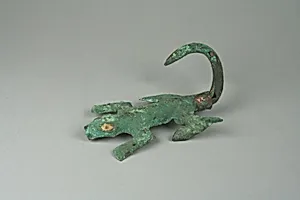
This exquisite *Animal Ornament*, crafted by an unknown Moche artist between the 6th and 7th centuries, depicts a lizard in dynamic repose, standing just 4-3/4 inches (12 cm) tall. Fashioned from gilded copper with shell inlays—likely for eyes or accents—it exemplifies the Moche mastery of metallurgy on Peru's northern coast. The gleaming gold surface, achieved through depletion gilding (a technique selectively removing copper to reveal a gold-rich layer), contrasts beautifully with the iridescent shell, creating a lifelike shimmer that would have caught the Andean sun. The Moche civilization (ca. A.D. 100–800), renowned for their monumental adobe pyramids and intricate ceramics, produced some of the finest pre-Columbian metalwork. Ornaments like this were elite status symbols, possibly worn as earspools, pectorals, or headdresses during rituals. Lizards, a recurring motif, may symbolize earth deities or regenerative forces in Moche cosmology, reflecting their deep connection to nature and the supernatural. Today, this piece from the Metropolitan Museum of Art's Arts of Africa, Oceania, and the Americas collection invites us to marvel at Moche ingenuity—transforming humble copper into treasures that bridged the mortal and divine worlds.