
Animal Ornament
Unknown Artist
6th–7th century
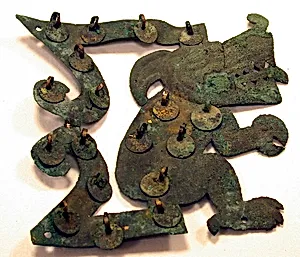
Medium
Gilded copper
Dimensions
H x W: 4 1/2 x 4 7/16in. (11.4 x 11.3cm)
Classification
Metal-Ornaments
Culture
Moche
Department
Arts of Africa, Oceania, and the Americas
Museum
Metropolitan Museum of Art, New York, NY
Credit
Bequest of Jane Costello Goldberg, from the Collection of Arnold I. Goldberg, 1986
Accession Number
1987.394.96
Rights
Public Domain
Tags
Art Historical Context
This exquisite *Animal Ornament*, crafted by an unknown Moche artist between the 6th and 7th centuries,ails from the ancient Moche culture of Peru's northern coast. The Moche, flourishing from around 100 to 700 CE, were masterful artisans renowned for their vivid depictions of animals, humans, and mythical beings in ceramics, textiles, and metals. This small gilded copper piece, measuring just 4½ x 4⅞ inches, likely served as personal adornment—perhaps a pendant or ear ornament—reflecting the elite status of its wearer in a society where such finery signified power and spiritual connection. The medium of gilded copper highlights the Moche's advanced metallurgical skills. Artisans hammered thin copper sheets into shape, then applied a thin layer of gold through depletion gilding or mercury amalgamation, creating a shimmering, luxurious surface that mimicked solid gold. Animals were central to Moche iconography, often symbolizing deities, fertility, or the natural world, blending realism with supernatural elements in their art. Housed in the Metropolitan Museum of Art's Department of the Arts of Africa, Oceania, and the Americas, this bequest from Jane Costello Goldberg captures the Moche's enduring legacy of technical innovation and symbolic depth. Visitors can marvel at how such a diminutive object encapsulated a vibrant worldview.