
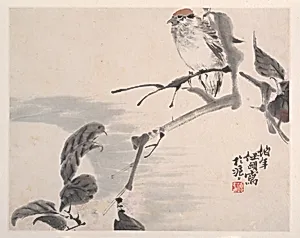
清 任頤 動物花鳥 冊頁八開|Animals, Flowers and Birds
19th century
Medium
Album of eight leaves; ink and color on paper
Dimensions
10 3/16 x 12 3/4 in. (25.9 x 32.4 cm)
Classification
Paintings
Culture & Period
China · Qing dynasty (1644–1911)
Department
Asian Art
Museum
Metropolitan Museum of Art, New York, NY
Credit
Gift of Robert Hatfield Ellsworth, in memory of La Ferne Hatfield Ellsworth, 1986
Accession Number
1986.267.47a–h
Rights
Public Domain
Tags
About this artwork
This album comprises eight leaves depicting various animals, flowers, and birds rendered in ink and color on paper, created by Ren Yi (Ren Bonian) in the nineteenth century. Each leaf measures approximately ten and three-sixteenths by twelve and three-quarter inches, presenting a diverse range of subjects executed with the spontaneous brushwork and vivid coloration characteristic of the Shanghai School. One leaf bears the artist's signature inscription: "Bonian, Ren Yi, painted this in Shanghai,...
Art Historical Context
This album of eight leaves Ren Yi (also known as Ren Bonian) captures the lively spirit of nineteenth-century Chinese painting through its depictions of animals, flowers, and birds. Created in ink and color on paper during the Qing dynasty, each intimate leaf combines spontaneous brushwork with vibrant hues. One leaf bears the artist’s inscription linking the work directly to Shanghai, where Ren established his mature practice, while poetic inscriptions throughout reflect the traditional Chinese harmony of painting, poetry, and calligraphy. Ren Yi (1840–1896) moved to Shanghai in 1855 after his father’s death, immersing himself in the city’s dynamic urban culture. As a leading figure of the Shanghai School, he blended classical techniques with the tastes of a rising merchant class, producing accessible yet sophisticated works that responded to increased contact with Western ideas and commercial demand. The album format itself highlights this modern synthesis, allowing viewers to appreciate diverse subjects in sequence while experiencing Ren’s expressive style. Gifted to the Metropolitan Museum, it offers a vivid window into a period of cultural transformation in China.