
Anklet
Unknown Artist
19th century
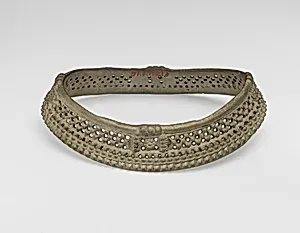
Medium
Silver or iron electroplated
Dimensions
H. 1 3/8 in. (3.5 cm) W. 5 7/16 in. (13.8 cm) D. 3 1/2 in. (8.9 cm) Wt. 5.7 oz. (161.6 g)
Classification
Jewelry
Department
Islamic Art
Museum
Metropolitan Museum of Art, New York, NY
Credit
Edward C. Moore Collection, Bequest of Edward C. Moore, 1891
Accession Number
91.1.1121
Rights
Public Domain
Art Historical Context
This elegant 19th-century ank, hailing from the Islamic Art collection at The Metropolitan Museum of Art, the intricate metalwork traditions of the Islamic world.ed through electroplating—a innovative 19th-century technique deposits a thin layer of silver (or possibly iron) onto a base—this piece measures just 1⅜ inches high, 5⅜ inches wide, and weighs a substantial 5.7 ounces, suggesting a sturdy design suited for wear around the ankle. Its modest dimensions belie its cultural weight, as anklets were cherished adornments in many Islamic societies, often worn by women to accentuate movement and signify status or marital bonds. Electroplating allowed artisans to create the luster of precious silver affordably, blending traditional craftsmanship with emerging industrial methods during a period of technological exchange across the Ottoman Empire, Persia, and beyond. Such jewelry reflected not only aesthetic beauty but also the wearer's social standing, with decorative motifs (though not specified here) typically drawing from floral, geometric, or calligraphic inspirations central to Islamic design. Acquired through the Edward C. Moore Collection and bequeathed to the Met in 1891, this anklet offers a glimpse into everyday luxury from a bygone era, inviting us to ponder the lives of those who once wore it with grace.