
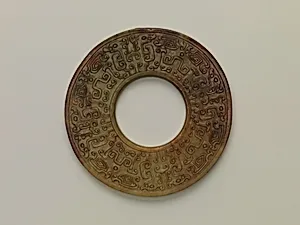
Annular Disk with Carved Designs
Unknown Artist
Medium
Jade (nephrite)
Dimensions
Diam. 4 7/8 in. (12.4 cm)
Classification
Jade
Culture & Period
China · Song (960–1279)–Qing (1644–1911) dynasty
Department
Asian Art
Museum
Metropolitan Museum of Art, New York, NY
Credit
Purchase, The Vincent Astor Foundation Gift, 2009
Accession Number
2009.100
Rights
Public Domain
Art Historical Context
Behold the *Annular Disk with Carved Designs*, a exquisite example of Chinese jade craftsmanship from the Metropolitan Museum of Art Asian Art collection. Craft from nephrite jade, this 4 7/8-inch (12.4 cm) diameter disk features a classic annular form—a flat ring with a central hole—orned with intricate carvings whose motifs evoke the refined aesthetics of imperial China. Acquired through the Vincent Astor Foundation in 2009, it bridges the Song (960–1279) and Qing (16441911) dynasties, periods renowned for their artistic sophistication. In Chinese culture, jade, particularly nephrite, held profound symbolic power, representing purity, immortality, and heavenly harmony. Annular disks like this one, known as *bi*, trace roots to Neolithic rituals but persisted as elite objects through dynastic eras. They were often used in burials, altars, or as talismans, their translucent green hue and polished surfaces embodying Confucian virtues. The unknown artisan's carving techniques—likely involving precise incising and polishing with abrasives—highlight the labor-intensive mastery required to transform tough nephrite into delicate, flowing designs. This disk invites us to ponder China's enduring jade tradition, where material and form merged art with cosmology, making it a timeless treasure for museum visitors.