
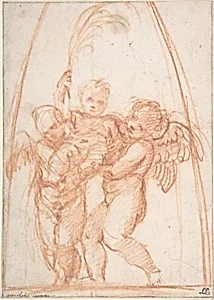
Anteros Victorious
1560–1609
Medium
Red chalk
Dimensions
sheet: 8 13/16 x 6 1/4 in. (22.4 x 16 cm)
Classification
Drawings
Department
Drawings and Prints
Museum
Metropolitan Museum of Art, New York, NY
Credit
Pfeiffer Fund, 1962
Accession Number
62.120.2
Rights
Public Domain
Art Historical Context
Annibale Carracci (1560–160) was a leading Italian artist who helped transition painting from Mannerism toward the dynamic naturalism of the early Baroque. Working primarily in Bologna and Rome, he championed a return to direct observation of nature while drawing inspiration from classical antiquity.Anteros Victorious,” executed in red chalk, exemplifies the intimate, exploratory character of his draftsmanship. The subject depicts Anteros, the Greek god of requited love and counterpart to Eros, in a moment of triumph. Red chalk, prized for its warm tonal range and ability to render soft modeling and expressive contours, was a favored medium for Carracci’s studies. On this modestly scaled sheet (roughly 8 13/16 by 6 1/4 inches), the artist conveys both narrative drama and anatomical vitality with economical yet fluid strokes. Acquired by the Metropolitan Museum of Art in 1962 through the Pfeiffer Fund, the drawing offers visitors a window into the creative process of one of the period’s most influential figures. Such works highlight how Carracci used drawing to explore mythological themes and emotional expression, bridging Renaissance ideals with the emerging Baroque sensibility.
About the Artist
Annibale Carracci · 1560–1609
Annibale was considered one of the greatest Italian painters of his age. His style is marked by naturalism combined with the formal language of Classicism in a grand and monumental style. Annibale was also instrumental in evolving the ideal, classical landscape and is generally credited with the invention of caricature. Italian painter. Comment on works: Mythology.