
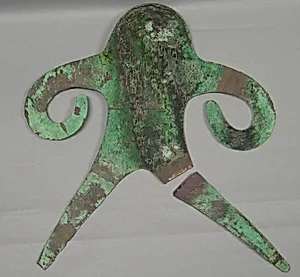
Anthropomorph with Leg Broken Off
Unknown Artist
1500–500 BCE
Medium
Copper
Dimensions
15 3/4 x 13 13/16 in. (40.0 x 35.1 cm)
Classification
Metalwork
Culture
India
Department
Asian Art
Museum
Metropolitan Museum of Art, New York, NY
Credit
Samuel Eilenberg Collection, Bequest of Samuel Eilenberg, 1998
Accession Number
2001.433.2
Rights
Public Domain
Art Historical Context
This enigmatic copper anthropomorph, titled *Anthropomorph with Leg Off*, hails from ancient India and dates to between 1500 and 500 BCE—a formative period bridging the late Indus Valley Civilization and the early Vedic age. Standing at nearly 16 inches tall (15 3/4 x 13 13/16 in.), this metalwork sculpture depicts a human-like figure, its form weathered by time, including a telltale broken leg that speaks to its antiquity and survival through millennia. Crafted from copper, a prized medium in ancient South Asia for its durability and luster, the piece exemplifies early metallurgical prowess. Indian metalworkers of this era mastered lost-wax casting and hammering techniques, producing ritual objects that blurred the line between human and divine. Though the artist remains unknown, such anthropomorphic figures likely served ceremonial or votive purposes, embodying deities, ancestors, or protective spirits in a culture rich with symbolic art. Now part of the Metropolitan Museum of Art's Asian Art collection, thanks to the Samuel Eilenberg Bequest of 1998, this artifact invites us to ponder the spiritual lives of ancient Indians. Its patina and imperfections remind us of the fragility of history, preserved as a window into a world where metal breathed life into the sacred.