
Antonin Proust
1885
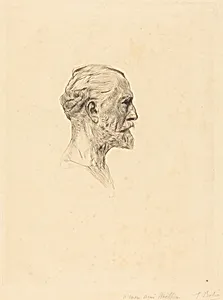
Medium
drypoint
Classification
Department
CG-E
Museum
National Gallery of Art, Washington, D.C.
Credit
Rosenwald Collection
Accession Number
1943.3.7403
Rights
Public Domain
Art Historical Context
In the heart of Auguste Rodin's multifaceted career stands *Antonin Proust* (1885), a drypoint print that reveals the sculptor's rare foray into printmaking. Rodin, renowned for his revolutionary bronze masterpieces like *The Thinker* and *The Gates of Hell*, captured the likeness of Antonin Proust, a prominent politician, journalist, and arts patron who championed modern artists such as Édouard Manet during his tenure as Minister of Fine Arts. Created amid the vibrant cultural ferment of Third Republic France, this intimate portrait bridges Rodin's sculptural prowess with the immediacy of graphic art. Drypoint, Rodin's chosen medium here, involves scratching directly into a metal plate with a sharp tool, raising a soft burr that yields velvety, expressive lines rich in texture and depth. Unlike smoother etching techniques, drypoint's tactile quality mirrors Rodin's obsession with surface and form, infusing the portrait with a sense of psychological depth and immediacy—hallmarks of his late-19th-century Realism tinged with emerging modernist sensibilities. Housed in the National Gallery of Art's Rosenwald Collection (Department CG-E), this print underscores Rodin's versatility and his connections to France's artistic elite. It invites visitors to appreciate how a master of three dimensions could distill human essence into a single, etched line, offering a window into the era's intellectual circles.
About the Artist
Auguste Rodin · 1840–1917
François Auguste René Rodin (1840-1917) stands as the founder of modern sculpture, transforming the art form from academic tradition into expressive modernism. Born into a working-class Parisian family, Rodin faced early rejection, failing three times to gain admission to the prestigious École des Beaux-Arts. This setback forced him to work as a craftsman for nearly two decades, though his 1875 tr...