
Antonio Vassilacchi
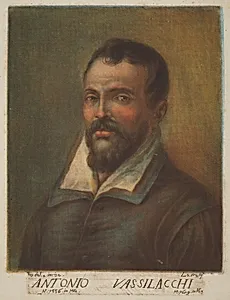
Medium
color mezzotint
Classification
Department
CG-E
Museum
National Gallery of Art, Washington, D.C.
Credit
Rosenwald Collection
Accession Number
1964.8.1166
Rights
Public Domain
Art Historical Context
This enchanting color mezzotint, titled *Antonio Vassilacchi* and created by Italian engraver Carlo Lasinio in 1789, pays homage to the 16th-century Greek-Italian painter Antonio Vassil (also known as Antonio Aliense). Produced "after" Vassilacchi, it likely reproduces a self-portrait or likeness of the Renaissance artist, who was renowned for his dramatic frescoes in Venetian churches like San Giorgio Maggiore. Lasinio, a master of reproductive prints during the late Enlightenment, captured Vassilacchi's dignified presence with remarkable fidelity, bridging centuries through art historical tribute. The medium—color mezzotint—is a highlight of technical virtuosity. Mezzotint, invented in the 17th century, involves rocking a copper plate to create a velvety black ground, then scraping highlights for luminous effects, ideal for portraits. Adding color was rare and innovative in 1789, lending the print a painterly glow that mimics oil paintings, making it a collector's gem in the National Gallery of Art's Rosenwald Collection. Housed in the museum's Prints department (CG-E), this work reflects the 18th-century fascination with rediscovering Renaissance masters amid neoclassical revival. It invites visitors to ponder how prints democratized access to illustrious figures, preserving Vassilacchi's legacy for modern eyes.