
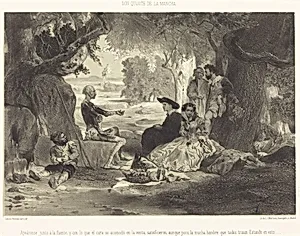
Apeáronse junto à la fuente...
c. 1855
Medium
color lithograph on wove paper
Dimensions
image: 21.5 x 30.8 cm (8 7/16 x 12 1/8 in.) sheet: 29.4 x 41.8 cm (11 9/16 x 16 7/16 in.)
Classification
Department
CG-E
Museum
National Gallery of Art, Washington, D.C.
Credit
Gift of Frank Anderson Trapp
Accession Number
2004.128.56
Rights
Public Domain
Art Historical Context
In the mid-19th century, artist Célestin Nuil (1813–1871) captured poetic vignettes through his mastery of lithography, as seen in *Apeáronse junto à la fuente...* (c. 1855). This evocative color lithograph on wove paper depicts a scene—its Spanish title translating to "They appeared next the fountain..."—evoking romantic encounters amid nature. Measuring 21.5 x 30.8 cm (image), the print's delicate scale invites intimate viewing, a hallmark of Nanteuil's illustrative style influenced by Romanticism. Lithography, perfected in the 19th century, allowed Nanteuil to layer vibrant colors directly from lithographic stones, producing rich tones and fine details unattainable in earlier printmaking. This chromolithograph exemplifies the era's technical leap, making high-quality art accessible beyond elite circles. Nanteuil, renowned for book illustrations and vignettes for poets like Victor Hugo, blended realism with fantasy, reflecting France's cultural fascination with exoticism and sentimentality. Today, housed in the National Gallery of Art's Prints department (gift of Frank Anderson Trapp), this work highlights lithography's role in democratizing art during the July Monarchy and Second Empire. Visitors can appreciate how Nanteuil's technique preserved fleeting romantic narratives for generations.