
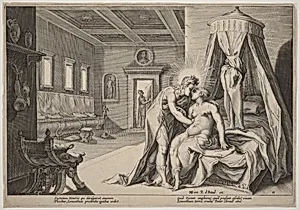
Apollo Abusing Leucothoe
Medium
engraving on laid paper
Dimensions
plate: 18.5 x 26 cm (7 5/16 x 10 1/4 in.) sheet: 19 x 26.7 cm (7 1/2 x 10 1/2 in.)
Classification
Department
CG-E
Museum
National Gallery of Art, Washington, D.C.
Credit
Gift of the Estate of Leo Steinberg
Accession Number
2011.139.137
Rights
Public Domain
Art Historical Context
In the National Gallery of Art's collection, *Apollo Abusing Leucoe* (c. 1615) is a striking engraving produced by the workshop of Hendrickoltzius, the renowned Dutch Mannerist artist, based on his own design. Goltzius (1558–1617) was a virtuoso engraver whose intricate lines captured dramatic mythological scenes with elegant, elongated figures and dynamic poses characteristic of Mannerism—a style bridging the Renaissance and Baroque eras. This print depicts a tense moment from Ovid's *Metamorphoses*, where the sun god Apollo ravishes the mortal princess Leucothoe, blending eroticism with tragedy in a tale of divine passion and mortal peril. Engraving on laid paper, a technique Goltzius perfected, involved incising designs into a copper plate with a burin to create rich, swelling lines that hold ink for printing. At 18.5 x 26 cm, this intimate plate size made it ideal for collectors, allowing widespread dissemination of Goltzius' masterful compositions. Produced posthumously by his workshop, it exemplifies the collaborative print culture of early 17th-century Northern Europe, where such works educated and delighted audiences with classical myths rendered in virtuoso technique. A gift from the Estate of Leo Steinberg, it invites visitors to appreciate the tactile depth and narrative intensity of old master prints.