
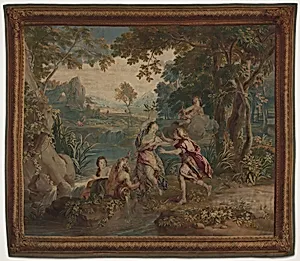
Apollo and Daphne
Medium
tapestry: undyed wool warp, dyed wool and silk weft
Classification
Decorative Art
Department
CSD
Museum
National Gallery of Art, Washington, D.C.
Credit
Gift of Lewis Einstein
Accession Number
1951.1.1
Rights
Public Domain
Art Historical Context
This magnificent tapestry captures the dramatic climax of the ancient myth from Ovid’s Metamorphoses, in which the god Apollo pursues the nymph Daphne. As she flees his advances, she calls upon her father, the river god Peneus, and is transformed into a laurel tree—her fingers sprouting leaves and her feet taking root in the earth. Designed by the French painter Charles de La Fosse around 1713–1721, the composition was translated into a full-scale cartoon by Brussels artists Zeger Jacob van Helmont and Augustin Coppens before being woven in the prestigious Leyniers-Reydams workshop. Created as a luxurious wall hanging, the tapestry demonstrates the extraordinary skill of early eighteenth-century Flemish weavers. Using undyed wool for the warp and a shimmering combination of dyed wool and silk for the weft, the artisans achieved luminous color gradations and delicate textures that bring the figures and landscape to life. Such large-scale narrative tapestries were prized by European courts and wealthy collectors, serving both as insulation for grand interiors and as visual declarations of cultural sophistication. Today, this work exemplifies the collaborative nature of tapestry production, where painters, cartoonists, and weavers worked together to transform classical stories into enduring works of decorative art. Its presence in the National Gallery of Art offers visitors a rare opportunity to appreciate both the timeless drama of the myth and the technical brilliance of Brussels tapestry weaving at its height.