
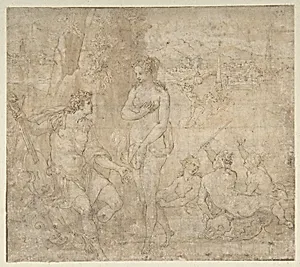
Apollo and Galatea in a Landscape with Neptune and Three Nymphs
1550–60
Medium
Pen and brown ink, brush and brown wash, over black chalk, squared for transfer in black chalk (with some corrections to squaring grid); traces of framing outlines in pen and dark brown ink
Dimensions
7 1/16 × 8 1/16 in. (18 × 20.5 cm)
Classification
Drawings
Department
Drawings and Prints
Museum
Metropolitan Museum of Art, New York, NY
Credit
Rogers Fund, 1961
Accession Number
61.20.5
Rights
Public Domain
Tags
Art Historical Context
This delicate drawing by Orazio Samacchini captures a lively mythological gathering set in an idyllic landscape. Created between 1550 and 1560, the composition brings together Apollo, the god of music and poetry, alongside the sea nymph Galatea, Neptune, and three attendant nymphs. Samacchini, a Bolognese artist active during the late Renaissance, skillfully arranges these figures to suggest both movement and harmony, inviting viewers to imagine the larger narrative unfolding beyond the sheet. The work’s medium—pen and brown ink with brush washes over black chalk—reveals the artist’s working process. Squared for transfer with visible corrections to the grid, the drawing was clearly a preparatory study intended for scaling up into a painting or fresco. This practical technique, common in sixteenth-century workshops, underscores the piece’s role as both a creative exploration and a functional tool for transferring designs. Beyond its technical interest, the scene reflects the period’s enduring fascination with classical mythology. By blending divine figures with a pastoral setting, Samacchini evokes themes of love, nature, and the sea that resonated strongly with Renaissance patrons and collectors. Today, such drawings offer intimate glimpses into how artists like Samacchini transformed ancient stories into vivid visual poetry.
About the Artist
Orazio Samacchini · 1532–1577
**Orazio Samacchini** (also spelled Sammachini; 20 December 1532 – 12 June 1577) was an Italian painter of the late Renaissance and Mannerist style, born and died in Bologna. He worked primarily in his native city but also received important commissions in Rome and Parma. Samacchini trained under Pellegrino Tibaldi, though some early sources also link him to Ercole Procaccini. His early work show...