
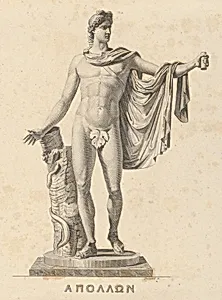
Apollo Belvedere
Asher Brown Durand, 1825
About this artwork
Behold the *Apollo Belvedere*, a 1825 engraving by B. Durand, capturing one of antiquity's most celebrated sculptures. Measuring just 7/8 by 7 5/8 inches, this print reproduces the iconic Vatican marble statue of Apollo, Greek god of music, poetry, and light, poised in dynamic contrapposto with bow in hand. Durand, then a promising 29-year-old engraver in York, honed his craft through such meticulous reproductions of classical masterpieces, bridging European Renaissance ideals with emerging American art. Engraving, Durand's chosen medium, involved incising fine lines into a metal plate with a burin, then inking and printing to create sharp, detailed images. This technique was revolutionary for democratizing high art, allowing collectors and scholars across the Atlantic to study the Apollo Belvedere's idealized anatomy and serene grace without traveling to Rome. As a Hudson River School founder's early work, it showcases Durand's precision before he turned to landscape painting. Today, this gem in the Metropolitan Museum of Art's Drawings and Prints collection—gifted by Mrs. Frederic F. Durand in 1930—evokes 19th-century neoclassical fervor, when Americans revered Greco-Roman forms as symbols of democratic virtue and beauty. A testament to art's enduring power to inspire.