
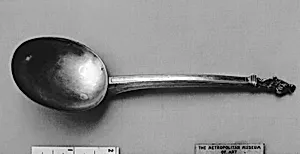
Apostle spoon
first half 17th century
Medium
Silver, parcel-gilt
Dimensions
Overall: 6 5/8 × 1 7/8 in. (16.8 × 4.8 cm)
Classification
Metalwork-Silver
Culture
German, Munich
Department
European Sculpture and Decorative Arts
Museum
Metropolitan Museum of Art, New York, NY
Credit
Gift of Mrs. Samuel P. Avery, 1897
Accession Number
97.2.101
Rights
Public Domain
Tags
Art Historical Context
This exquisite *Apostle spoon*, in Munich around the first half of the17th century by silversmiths Hans Sch, Jacob Wilhelm, and Albertin, exemplifies the pinnacle of German Baroque metalwork. Fashioned from silver with selective parcel-gilding—where thin gold leaf is applied to highlights for a luxurious shimmer—the spoon measures a dainty 6⅝ × 1⅞ inches. Its finial likely depicts one of the Christian Apostles, a hallmark of this revered form of tableware that blended functionality with deep religious symbolism. Apostle spoons emerged in Europe during the late Middle Ages and flourished into the 17th century, often produced in sets of 12 (or 13 including Christ) as lavish christening gifts for the elite. Made in the prosperous silver hub of Munich, this piece reflects the era's opulent craftsmanship amid the Thirty Years' War, when such objects served as portable expressions of faith and status. The collaborative marks of three makers underscore the guild-based workshops that ensured precision in chasing, engraving, and gilding techniques. Today, housed in the Metropolitan Museum of Art's European Sculpture and Decorative Arts Department (gift of Mrs. Samuel P. Avery, 1897), it invites us to savor the artistry of everyday devotion, bridging Renaissance piety with Baroque grandeur.
About the Artist
Hans Schleich|Jacob Wilhelm|Heinrich Albertin ( | | ) · 1516 |1539 |1525 –1616 |1639 |1625
master 1582, died 1616|master 1593, died 1639|master 1599, died 1625