
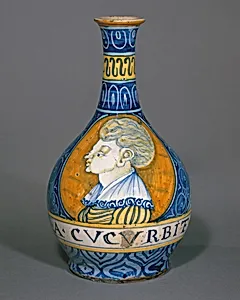
Apothecary bottle (fiasca da farmacia)
Unknown Artist
ca. 1530–40
Medium
Maiolica (tin-glazed earthenware)
Dimensions
Height: 9 5/8 in. (24.5cm)
Classification
Ceramics-Pottery
Culture
Italian, Castelli
Department
Robert Lehman Collection
Museum
Metropolitan Museum of Art, New York, NY
Credit
Robert Lehman Collection, 1975
Accession Number
1975.1.1042
Rights
Public Domain
Tags
Art Historical Context
This elegant apothecary bottle, known as a *fiasca da farm*, hails from Castelli, Italy, around 1530–40, a golden era for maiolica production during the Renaissance. Crafted tin-glazed earthenware, stands just 9 5/8 inches (24.5 cm) tall, designed for practical use in pharmacies to store medicines, oils, or herbal remedies. Castelli was renowned for its vibrant ceramics, blending utility with artistry, and this piece exemplifies the region's mastery in creating durable yet beautifully decorated vessels. The tin glaze technique was revolutionary, providing a smooth, white surface ideal for vivid colors and intricate designs—here featuring male profiles, evoking classical antiquity through stylized portraits reminiscent of ancient Roman coins. These motifs highlight the Renaissance revival of Greco-Roman aesthetics, infusing everyday objects with scholarly elegance. As part of the Robert Lehman Collection at The Metropolitan Museum of Art, it offers a glimpse into 16th-century Italian apothecary culture, where science and art converged. Today, such fragile survivors remind us of the apothecary's vital role in pre-modern medicine, bridging pharmacology and decorative arts in a single, luminous form.