
Appliqué
Unknown Artist
19th century
Medium
Bone
Dimensions
Overall: 10 1/16 x 2 5/8 x 13/16 in. (25.6 x 6.7 x 2 cm)
Classification
Bone
Culture
European (Byzantine style)
Department
Medieval Art
Museum
Metropolitan Museum of Art, New York, NY
Credit
Fletcher Fund, 1947
Accession Number
47.100.78
Rights
Public Domain
Tags
Art Historical Context
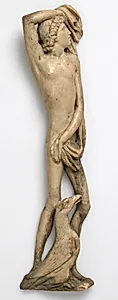
This delicate bone appliqué, crafted by an unknown artist in 19th-century Europe, exemplifies a revival of Byzantine style within the Metropolitan Museum of Art Medieval Art collection. Measuring just 10 1/16 x 2 5/8 x 13/16 inches, this small sculpture likely served as a decorative attachment for religious objects like reliquaries, book, or liturgical items. Acquired through the Fletcher Fund in1947, it showcases the enduring influence of Byzantine aesthetics—characterized by intricate carving, symbolic motifs, and flattened, hierarchical composition—long after the empire's fall. Bone, a favored medium in Byzantine and medieval art for its fine grain and workability, allowed artisans to achieve exquisite detail in low-relief sculpture. Here, birds emerge as the central motif, a common emblem in Byzantine iconography symbolizing the soul, paradise, or divine messengers. The appliqué's precise incisions and polished surfaces highlight masterful techniques suited to its modest scale, blending functionality with spiritual depth. Though dated to the 19th century, its classification reflects a nostalgic echo of medieval traditions, inviting visitors to ponder the continuity of artistic heritage across centuries. A charming gem for bird enthusiasts and Byzantine admirers alike!