
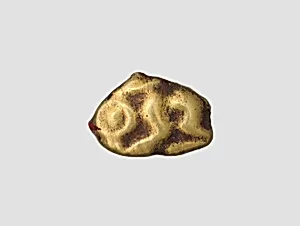
Appliqué with recumbent hares
Unknown Artist
ca. 7th–6th century BCE
Medium
Gold
Dimensions
5/16 × 7/16 × 1/8 in. (0.79 × 1.1 × 0.25 cm)
Classification
Metalwork-Ornaments
Culture
Scythian
Department
Ancient Near Eastern Art
Museum
Metropolitan Museum of Art, New York, NY
Credit
Rogers Fund, 1965
Accession Number
65.162.1
Rights
Public Domain
Tags
Art Historical Context
This delicate gold appliqué, depicting two recumbent hares, hails from Scythian culture around the 7th–6th century BCE. Measuring just 5/16 × 7/16 × 1/8 inches, this tiny ornament exemplifies the extraordinary finesse of ancient metalworkers from the Eurasian steppes. Crafted from pure gold, it was likely to clothing, horse harnesses, or weaponry, serving both decorative and talismanic purposes in the nomadic world of the Scythians—fierce horse-riding warriors renowned for their opulent burials filled with such treasures. Scythian art often featured dynamic animal motifs, symbolizing vitality, speed, and the natural world central to their pastoral lifestyle. Hares, with their alert yet resting poses here, may evoke themes of fertility, agility, or the hunt, common in steppe iconography. The appliqué's repoussé technique—hammering gold from the reverse to create raised forms—lights advanced metallurgical skills, possibly involving lost-wax casting or chasing for fine details. Acquired through the Rogers Fund in 1965, this piece from The Metropolitan Museum of Art's Ancient Near Eastern collection offers a glimpse into Scythian prestige and artistry, bridging the ancient Near East and nomadic frontiers. Its preservation underscores the enduring allure of these "gold people," whose crafts influenced later Eurasian traditions.