
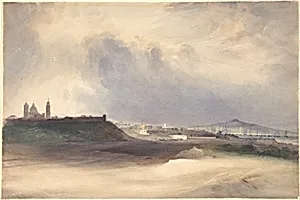
Approach to Montevideo, Uruguay
1832
Medium
Watercolor over graphite
Dimensions
sheet: 7 13/16 x 11 11/16 in. (19.8 x 29.7 cm)
Classification
Drawings
Department
Drawings and Prints
Museum
Metropolitan Museum of Art, New York, NY
Credit
Purchase, Mrs. Carl L. Selden Gift, in memory of Carl L. Selden, 1993
Accession Number
1993.8
Rights
Public Domain
Tags
Art Historical Context
**Approach to Montevideo, Uruguay** (1832) by Conrad captures a serene coastal vista of the Uruguayan capital as seen from approaching ships, rendered in watercolor over graphite on a modest 7 13/16 x 11 11/16-inch sheet. Martens, a skilled British landscape artist, created this intimate drawing during his time aboard HMS *Beagle*—the same voyage that carried Charles Darwin on his groundbreaking scientific expedition. The work depicts the city's distinctive skyline of buildings and churches against the horizon, evoking the bustling port's role as a strategic hub in early 19th-century South America amid Uruguay's turbulent fight for independence from Brazil and Argentina. Martens' technique exemplifies Romantic-era precision: faint graphite underdrawings provide structural accuracy, overlaid with translucent watercolors that masterfully convey atmospheric light, sea haze, and subtle tonal shifts. This method allowed him to document exotic locales vividly, blending scientific observation with artistic lyricism. As a rare survivor from his *Beagle* sketches, the piece offers a window into 1830s maritime exploration and Martens' influence on Australian landscape painting after he settled there. Today, housed in the Metropolitan Museum of Art's Drawings and Prints department (Purchase, Mrs. Carl L. Selden Gift, 1993), it highlights how watercolor sketches bridged exploration journals and fine art, inviting visitors to trace the paths of discovery.