
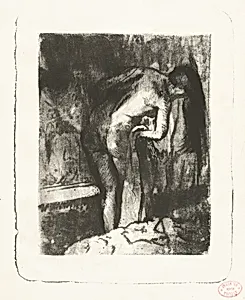
Après le Bain II (After the Bath II)
1891-1892
Medium
lithograph on wove paper
Dimensions
image: 19.05 × 14.92 cm (7 1/2 × 5 7/8 in.) sheet: 30.32 × 21.91 cm (11 15/16 × 8 5/8 in.)
Classification
Department
CG-E
Museum
National Gallery of Art, Washington, D.C.
Credit
Purchased for the Virginia and Ira Jackson Collection and Ailsa Mellon Bruce Fund
Accession Number
2018.162.1
Rights
Public Domain
Art Historical Context
Step into the intimate world of Degas with *Après le Bain II ( the Bath II)*, delicate lithograph created between 1891 and 1892. Degas, a leading French Impressionist known for his fascination with the female form in everyday moments, captured women in private acts like bathing with a voyeuristic yet respectful gaze. This print belongs to his renowned series exploring bathers, reflecting his lifelong interest in modern life and the female nude, often observed from unconventional angles to emphasize natural movement and vulnerability. Printed on wove paper, the modest image measures just 19.05 × 14.92 cm, inviting close contemplation of its subtle textures and fluid lines. Lithography, a technique Degas mastered late in his career, allowed him to blend drawing's spontaneity with printmaking's precision, producing rich tonal effects through grease crayon and tusche. This medium was revolutionary for artists seeking affordable multiples while retaining painterly qualities, bridging fine art and reproduction. Housed in the National Gallery of Art's Virginia and Ira Jackson Collection (purchased with the Ailsa Mellon Bruce Fund), this work exemplifies Degas' innovative printmaking during his later years, when declining eyesight pushed him toward monotypes and lithography. It offers visitors a window into 19th-century Paris, where private rituals became subjects of profound artistic beauty.
About the Artist
Edgar Degas · 1834–1917
Edgar Degas (1834-1917) stands as one of the most innovative artists of the nineteenth century, whose distinctive vision transformed how modern life could be depicted on canvas. Born Hilaire-Germain-Edgar De Gas in Paris to a wealthy banking family—his father French, his mother a Louisiana Creole from New Orleans—Degas received a classical education before abandoning law studies in 1855 to pursue ...