
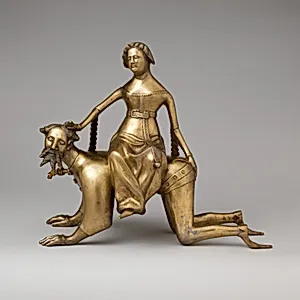
Aquamanile in the Form of Aristotle and Phyllis
Unknown Artist
late 14th or early 15th century
Medium
Bronze; Quaternary copper alloy (approx. 72% copper, approx. 17% zinc, approx. 6% lead, approx. 3% tin).
Dimensions
H. 32.5 cm, w. 17.9 cm, l. 39.3 cm, wt. 6062 g.
Classification
Metalwork-Bronze
Culture
South Netherlandish
Department
Robert Lehman Collection
Museum
Metropolitan Museum of Art, New York, NY
Credit
Robert Lehman Collection, 1975
Accession Number
1975.1.1416
Rights
Public Domain
Tags
Art Historical Context
Welcome to the Metropolitan Museum of's Robert Lehman Collection, where this intriguing South Netherlandish bronze aquile from the late 14th or early 15th century captivates visitors. Shaped as a figural vessel standing 32.5 cm tall, it depicts the philosopher Aristotle on all fours, ridden triumphantly by Phyllis—a nod to a popular medieval legend. In the tale, the seductive Phyllis humiliates Aristotle, who had advised King Alexander the Great to avoid women, symbolizing timeless power of love (or lust) over wisdom. Aquamaniles like this were practical ewers for handwashing during meals or rituals, blending utility with storytelling in late Gothic metalwork. Crafted from a quaternary copper alloy (about 72% copper, 17% zinc, 6% lead, and 3% tin), this 6 kg masterpiece showcases advanced casting techniques from the South Netherlands, a hub for high-quality bronzes. The detailed modeling of faces, drapery, and dynamic pose reflects the era's naturalistic tendencies amid Gothic elegance, making it both functional art and moral commentary. Acquired in 1975, it invites us to ponder gender dynamics and human folly through a beautifully preserved relic of medieval life.