
Arab Market
1826 to 1850
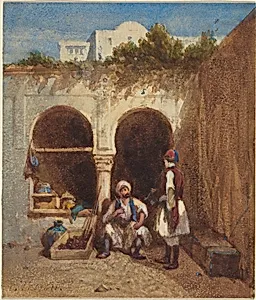
Medium
watercolor
Dimensions
sheet: 15.2 x 13.1 cm (6 x 5 3/16 in.)
Classification
Drawing
Department
CG-E
Museum
National Gallery of Art, Washington, D.C.
Credit
Gift of Frank Anderson Trapp
Accession Number
2004.166.35
Rights
Public Domain
Art Historical Context
Louis Tesson's "Arab Market" is a delicate watercolor created between 1826 and 1850. This small drawing, measuring just 15.2 by 13.1 centimeters, reflects the intimate scale often chosen for works on paper during the early to mid-nineteenth century. As a drawing in the National Gallery of Art's collection, it invites viewers to examine the fine details and subtle layering possible in this medium. Watercolor was prized in this era for its portability and luminous qualities, allowing artists to record scenes with fluid washes and vibrant yet transparent color. Tesson's work demonstrates these strengths, producing an engaging composition that captures atmosphere through light and line rather than heavy opacity. Generously donated by Frank Anderson Trapp, the piece enriches the museum's holdings of drawings and offers visitors a window into nineteenth-century artistic practice. Its modest size encourages close looking, revealing the technical finesse that made watercolor a favored choice for both study and finished art.
About the Artist
Louis Tesson · 1841–1867
**Louis Tesson (1820–1870)** was a French genre painter, landscape artist, and Orientalist known for his evocative watercolors and pastels depicting everyday scenes, North African life, and coastal subjects. Born in Calais in the Pas-de-Calais region, he trained under the prominent Romantic painter Alexandre Gabriel Decamps, whose influence is evident in Tesson’s attention to exotic locales and at...