
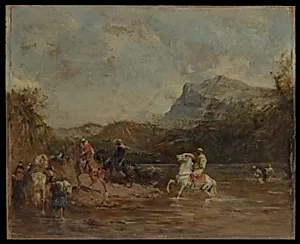
Arabs Crossing a Ford
1873
Medium
Oil on wood
Dimensions
20 x 24 1/2 in. (50.8 x 62.2 cm)
Classification
Paintings
Department
European Paintings
Museum
Metropolitan Museum of Art, New York, NY
Credit
Catharine Lorillard Wolfe Collection, Bequest of Catharine Lorillard Wolfe, 1887
Accession Number
87.15.64
Rights
Public Domain
Tags
Art Historical Context
Eugène Fromentin's *Arabs Crossing a Ford* (1873) captures a dynamic moment of North African daily life, with riders on horseback navigating a shallow river amid rolling hills. Painted in oil on wood—a compact panel format of 20 x 24½ inches—this intimate work evokes the vastness of the Algerian landscape through Fromentin's masterful handling of light and atmosphere. The scene's vivid details, from the rippling water to the fluid motion of horses and figures, draw viewers into an exotic yet authentic vista. Fromentin, a French artist and writer (1820–1876), was a leading figure in the Orientalist movement, which romanticized the Middle East and North Africa in 19th-century European art. His multiple trips to Algeria in the 1840s and 1850s informed works like this, blending realism with poetic idealism to portray Arab nomads and their environment. Unlike more fantastical Orientalist fantasies, Fromentin's paintings emphasize lived experience, influenced by his literary pursuits and on-site sketches. Acquired through the Catharine Lorillard Wolfe Collection in 1887, this piece resides in the Metropolitan Museum of Art's European Paintings department. It exemplifies how Orientalism shaped Western perceptions of the "Orient," offering today’s visitors a window into colonial-era artistic fascination with cultural "otherness" while highlighting Fromentin's technical prowess in capturing movement and luminosity.