
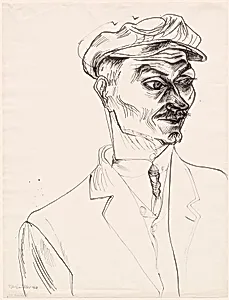
Arbeiter (Worker)
Medium
pen and black ink on laid paper
Dimensions
sheet: 64.77 × 49.53 cm (25 1/2 × 19 1/2 in.)
Classification
Drawing
Department
CG-W
Museum
National Gallery of Art, Washington, D.C.
Credit
Gift of Ruth Cole Kainen
Accession Number
2012.92.34
Rights
Public Domain
Art Historical Context
**Arbeiter (Worker)**, created by German artist Conrad Felixmüller in1921, captures the essence of labor during the turbulent Weimar Republic era Felixmüller, a key figure in early 20th-century Expressionism associated with the Dresden Secession Group 9, often depicted everyday people with raw emotional intensity. This pen and black ink drawing on laid paper—measuring a substantial 64.77 × 49.53 cm—showcases his commitment to social realism, portraying the worker as a symbol of-World War I struggle amid economic hardship and political upheaval in Germany. The medium of pen and ink lends itself to Felixmüller's precise yet expressive line work, where bold strokes and intricate hatching build form and texture on the textured laid paper, a traditional support that enhances the drawing's tactile quality. Unlike oil paintings, such drawings allowed for quick, spontaneous sketches that conveyed urgency, making them vital in Expressionist practice for exploring human conditions without idealization. Housed in the National Gallery of Art as a gift from Ruth Cole Kainen, *Arbeiter* invites visitors to reflect on the dignity of manual labor and the artist's humanist gaze. Its stark monochrome palette underscores the era's austerity, reminding us how art became a voice for the voiceless in interwar Europe.