
Arc-shaped pendant (<em>huang</em> 璜)
ca. 3500-2700 BCE
Classification
Jewelry and Ornament
Department
Smithsonian Collection
Museum
Smithsonian American Art Museum
Credit
Gift of Charles Lang Freer
Accession Number
F1917.383
Rights
Public Domain
Tags
About this artwork
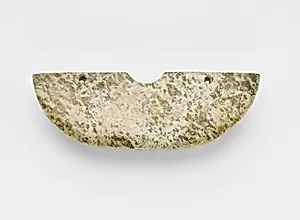
Ornament: type huang 璜; small flat plaque with oval upper edge and straight base with curved notch in center; mottled pale yellow green and cream; reverse covered with white incrustation; two functional holes conically bored from both sides; irregularities in cutting, two saw marks.
Art Historical Context
This delicate arc-shaped pendant, known as a *huang* (璜), dates to China's Late Neolithic period (ca. 3500-2700 BCE). Craft from mottled pale yellow-green and cream nephrite jade, features a small flat plaque an oval upper edge, a straight base, and a curved notch at the center. Two conically bored holes suggest it was worn or suspended, while subtle irregularities in cutting and saw marks reveal the handiwork of ancient artisans using basic stone tools. In Neolithic China, jade like nephrite held profound cultural and ritual significance, symbolizing purity, status, and connection to the spiritual world. *Huang* pendants were prized ornaments, often part of elite burials or ceremonies, reflecting advanced carving techniques that foreshadowed the sophisticated jade traditions of later dynasties. This piece exemplifies the era's reverence for jade's translucence and durability. A gift from collector Charles Lang Freer, it now graces the Smithsonian American Art Museum's collection, offering a window into one of humanity's earliest masterpieces of adornment and artistry.
About the Artist
Unknown
The artist designated as "Unknown" in our virtual museum's collection exemplifies a poignant chapter in art history: creators whose identities have faded into obscurity despite the enduring power of their work. With only one known artwork attributed to them in our holdings, this figure represents countless anonymous hands that shaped visual culture across centuries. Museums worldwide, including th...