
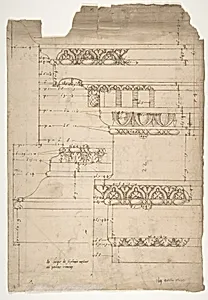
Arch of Septimius Severus, entablature, elevation; attic, base, elevation (recto) Arch of Septimius Severus, archivolt, elevation; impost, elevation; entablature, elevation; column base, elevation; column, plan (verso)
early to mid-16th century
Medium
Dark brown ink, black chalk, and incised lines
Dimensions
sheet: 16 15/16 x 12 5/8 in. (43 x 32 cm)
Classification
Drawings|Ornament & Architecture
Department
Drawings and Prints
Museum
Metropolitan Museum of Art, New York, NY
Credit
Purchase, Rogers Fund, Joseph Pulitzer Bequest, and Mark J. Millard Gift, 1968
Accession Number
68.769.11
Rights
Public Domain
Tags
Art Historical Context
This exquisite 16th-century drawing, created anonymously by a French artist, captures intricate details of the ancient Roman of Septimius Severus Rome. On the recto, it presents elevations of the entablature attic base, while the features elevations of the archivolt, impost, entablature column base, and a column plan. Rendered in dark brown ink, black chalk and incised lines on generous sheet measuring 16 15/16 x 12 5/8 inches, this work exemplifies Renaissance draftsmen's passion for precisely documenting classical architecture. Dating to the early to mid-1500s, the drawing reflects the era's fervent revival of antiquity during the French Renaissance. Artists and architects traveled to Rome to study monuments like the Arch of Septimius Severus—built around 203 CE to honor Emperor Septimius Severus's Parthian victories. Such measured studies served practical purposes: incised lines allowed tracings for engravings, sculptures, or new designs, bridging ancient grandeur with contemporary innovation. Housed in the Metropolitan Museum of Art's Drawings and Prints department, this piece highlights the meticulous techniques of ornamental and architectural draughtsmanship. It invites us to appreciate how 16th-century creators preserved Rome's legacy, fueling the spread of classical motifs across Europe. A testament to enduring curiosity, it reminds visitors of architecture's timeless dialogue between past and present.