
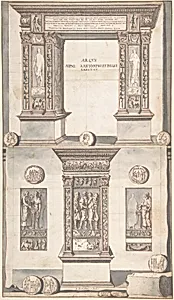
Arch of Septimius Severus, Frontal Elevation (above) and Side View (below)
before 1704
Medium
Red chalk, pen and brown and black ink, brush and gray wash, over black chalk
Dimensions
14 1/16 x 8 9/64 in. (35.7 x 20.7 cm)
Classification
Drawings
Department
Drawings and Prints
Museum
Metropolitan Museum of Art, New York, NY
Credit
Gift of Helen and János Scholz, 1958
Accession Number
58.648.2(24)
Rights
Public Domain
Tags
Art Historical Context
Step into the grandeur of ancient Rome through Jan Goeree's meticulous drawing of the *Arch of Septimius, Frontal Elevation (above) and Side Viewbelow)*, created before 1704 Dutch artist and engraver Janeree, active in the 17th and early 18th centuries, captured this iconic triumphal arch in Rome with architectural precision. Built around 203 AD to celebrate Emperor Septimius Severus's in Parthia, the arch stands as a masterpiece of Roman engineering, adorned with intricate reliefs depicting military triumphs and imperial family scenes. Goeree's work reflects the era's fascination with classical antiquities, as artists and scholars traveled to Italy to document ancient wonders amid the Baroque revival of Roman forms. Presented in both frontal and side elevations, the drawing served as a vital study aid for architects, designers, and antiquarians, preserving the monument's proportions and details for posterity. Crafted on a modest sheet measuring 14 1/16 x 8 9/64 inches, Goeree employed a layered technique: black chalk underdrawing for structure, heightened with red chalk, pen in brown and black inks for crisp lines, and gray wash for subtle shading and depth. This multi-medium approach brings the stone's texture and shadows to life, showcasing Dutch draftsmanship's blend of accuracy and artistry. A gift to the Metropolitan Museum of Art in 1958, it invites us to marvel at Rome's enduring legacy.
About the Artist
Jan Goeree · 1670–1731
Comment on works: Painter; Draughtsman; Engraver; History; Subjects in landscapes