
Arch of Titus
1651 to 1700
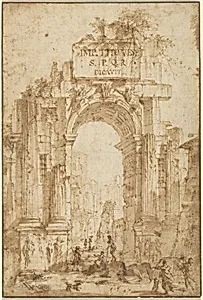
Medium
pen and brown ink and brown wash on laid paper
Dimensions
overall: 18.7 x 12.2 cm (7 3/8 x 4 13/16 in.)
Classification
Drawing
Department
CG-E
Museum
National Gallery of Art, Washington, D.C.
Credit
Gift of Benjamin and Lillian Hertzberg
Accession Number
2004.140.26
Rights
Public Domain
Art Historical Context
This delicate drawing captures the majestic Arch of Titus, one of Rome's most iconic ancient monuments, built in 81 AD by Emperor Domitian to celebrate his brother Titus's victory over. Erected along the Via Sacra in the Roman Forum, the arch famously depicts the spoils of the Temple in Jerusalem, including the golden menorah, symbolizing Rome's imperial triumph. Created between 1651 and 1700 by an artist in the circle of Giovanni Paolo Panini—a master of Roman vedute (topographical views)—this work reflects the 17th-century fascination with classical antiquity during the Baroque era, when scholars and artists avidly documented ancient ruins. Executed in pen and brown ink with brown wash on laid paper, the small-scale piece (just 18.7 x 12.2 cm) showcases meticulous line work for architectural precision and subtle wash for depth and shadow, evoking the arch's grandeur despite its intimate size. Such drawings often served as studies for paintings, souvenirs for Grand Tour travelers, or records amid Rome's urban changes. Housed in the National Gallery of Art thanks to the gift of Benjamin and Lillian Hertzberg, this artwork bridges ancient history and artistic tradition, inviting visitors to ponder Rome's enduring layers—from pagan triumphs to Renaissance rediscovery.