
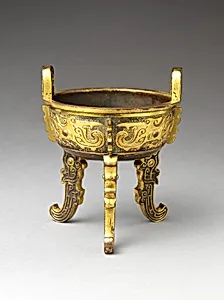
청동 향로 중국 명|靑銅香爐 中國 明|Archaistic tripod censer (Ding)
Unknown Artist
17th century
Medium
Parcel-gilt bronze
Dimensions
H. 7 in. (17.8 cm); W. 5 5/8 in. (14.3 cm); D. 5 3/4 in. (14 cm)
Classification
Metalwork
Culture & Period
China · Ming dynasty (1368–1644)
Department
Asian Art
Museum
Metropolitan Museum of Art, New York, NY
Credit
Purchase, Friends of Asian Art Gifts, 2019
Accession Number
2019.315
Rights
Public Domain
Art Historical Context
This exquisite parcel-gilt bronze tripod censer, known as a *ding*, hails from China's Ming dynasty in the 17th century Standing just 7 inches tall, its compact form—5⅝ inches wide and 5¾ inches deep—echoes the ancient ritual vessels of the Shang and Zhou dynasties, a style revived during the Ming era through archaism. Craftsmen intentionally mimicked archaic motifs, such as taotie masks and thunder patterns, to evoke the grandeur of China's Bronze Age, blending reverence for the past with contemporary elegance. Fashioned from bronze with selective gilding that highlights intricate details, this metalwork exemplifies Ming technical mastery. The three-legged *ding* shape was originally used for cooking sacrificial offerings, but by the Ming period, it served as an incense burner in temples, scholarly studios, and homes. Incense rituals promoted harmony and spiritual focus, making such censers essential to daily Confucian and Buddhist practices. Acquired by the Metropolitan Museum of Art in 2019 through the Friends of Asian Art, this piece captures the Ming court's fascination with antiquity amid political upheaval. Its subtle gilding and patina invite visitors to appreciate the fusion of form, function, and cultural memory in everyday luxury.