
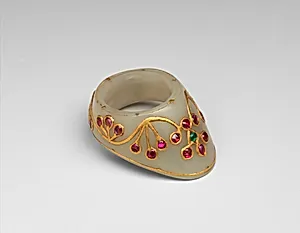
Archer's Ring
Unknown Artist
17th–18th century
Medium
Jade, gold, rubies, emeralds
Dimensions
L. 1 3/4 in. (4.4 cm); W. 1 1/4 in. (3.2 cm); Wt. 1 oz. (28.3 g)
Classification
Archery Equipment-Archer's Ring
Culture
Indian
Department
Arms and Armor
Museum
Metropolitan Museum of Art, New York, NY
Credit
Bequest of George C. Stone, 1935
Accession Number
36.25.2796
Rights
Public Domain
Art Historical Context
This exquisite Archer's Ring, crafted in India during the 17th–18th century, exemplifies the fusion of functionality and opulence in Mughal-era archery gear. Measuring just 1¾ inches long and weighing a single ounce, this thumb protector was essential for archers drawing heavy composite bows. Worn on the right thumb, it shielded the digit from the sharp sting of the bowstring, allowing for precise, powerful shots—a technique central to Indian warfare and hunting traditions. Fashioned from lustrous jade inlaid with gold, rubies, and emeralds, the ring showcases masterful lapidary techniques. The translucent green jade, prized for its durability and symbolic purity, forms the body, while gemstones add vibrant accents and royal prestige. Such lavish materials elevated these rings from mere tools to status symbols for nobility and warriors, reflecting the era's patronage of skilled artisans. Housed in the Metropolitan Museum of Art's Arms and Armor Department through the 1935 bequest of George C. Stone, this piece offers a glimpse into India's rich martial heritage. Marvel at how beauty and battle intertwined in everyday objects of the past!