
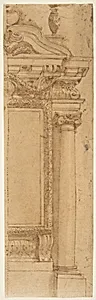
Architectural Design Presenting Two Alternate Solutions (in two fragments)
17th century
Medium
Pen and brown ink, brush and brown wash, over leadpoint.
Dimensions
10 3/4 x 3 5/16 in. (27.3 x 8.4 cm)
Classification
Drawings
Department
Drawings and Prints
Museum
Metropolitan Museum of Art, New York, NY
Credit
The Elisha Whittelsey Collection, The Elisha Whittelsey Fund, 1958
Accession Number
58.543.32
Rights
Public Domain
Tags
Art Historical Context
This delicate 17th-century architectural drawing, created anonymously by an Italian artist, presents two alternate design solutions for a columnar structure, preserved in two fragments. Rendered in pen and brown ink with brush and brown wash overpoint on a slender sheet measuring just 10 3/4 x 3 5/16 inches, it exemplifies the preparatory sketches vital to Italy's Baroque era. The narrow format suggests it was a focused study, for a facade, portico, or interior element where columns played a starring role—hallmarks of the period's dramatic, illusionistic architecture. In the exuberant world of 17th-century Italy, architects like Gian Lorenzo Bernini and Francesco Borromini pushed boundaries with innovative column arrangements to evoke movement and grandeur in churches and palaces. Such drawings, using leadpoint for initial underdrawing and layered inks for depth and shadow, allowed designers to experiment rapidly before committing to stone or stucco. The brown wash adds a subtle three-dimensionality, mimicking light on sculpted forms and highlighting the era's obsession with spatial drama. Today, this fragment from The Metropolitan Museum of Art's Elisha Whittelsey Collection offers a window into the creative process behind Italy's architectural masterpieces, reminding us how humble sketches birthed enduring wonders. (198 words)