
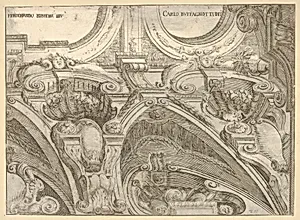
Architectural detail of an elaborate cornice, seen from below
Medium
Etching
Dimensions
Sheet (Trimmed): 7 3/16 × 9 13/16 in. (18.3 × 25 cm)
Classification
Prints
Department
Drawings and Prints
Museum
Metropolitan Museum of Art, New York, NY
Credit
Bequest of Phyllis Massar, 2011
Accession Number
2012.136.153
Rights
Public Domain
Tags
Art Historical Context
This exquisite etching captures an elaborate Baroque cornice viewed dramatically from below, showcasing the intricate scrollwork, volutes, and ornamental flourishes typical of late 17th-century architecture Created between 1680 and 1710 by Carlo Buffagnotti and Ferd Galli Bibiena—members of the renowned Bibiena family of Italian architects, painters, and stage designers—it exemplifies their mastery in rendering architectural grandeur through printmaking. The trimmed sheet measures just 7 3/16 × 9 13/16 inches, yet its upward gaze evokes the awe-inspiring scale of palatial interiors or theatrical scenography. Etching, the medium here, allowed artists like Bibiena to achieve fine lines and tonal depth by biting acid into a metal plate, producing detailed reproductions that disseminated architectural ideas across Europe. Bibiena's innovative "scena per angolo" perspective technique, often seen in his opera sets, heightens the cornice's dynamism, making it appear to thrust toward the viewer. This print reflects the Baroque era's emphasis on opulence and illusion, bridging architecture and the performing arts during a time when grand designs symbolized power and piety. Today, housed in the Metropolitan Museum of Art's Drawings and Prints department through the bequest of Phyllis Massar in 2011, this work invites us to appreciate how prints preserved ephemeral architectural visions, influencing designers for centuries.