
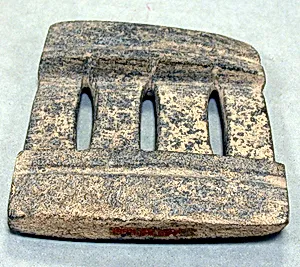
Architectural Model
Unknown Artist
1st–8th century
Medium
Stone
Dimensions
Height 3-7/8 in.
Classification
Stone-Sculpture
Culture
Mezcala
Department
Arts of Africa, Oceania, and the Americas
Museum
Metropolitan Museum of Art, New York, NY
Credit
Bequest of Arthur M. Bullowa, 1993
Accession Number
1994.35.667
Rights
Public Domain
Tags
Art Historical Context
This delicate stone Architectural Model, crafted by an unknown artist of the Mezcala culture between the 1st and 8th centuries CE offers a rare glimpse into ancient Mesoamerican. Hailing from the Balsas River region of Guerrero, Mexico, this 3-7/8-inch-high sculpture—likely pecked and polished from hard local stone—depicts a stepped temple or shrine, a form echoed in later Mesoamerican pyramids. Its compact scale belies its monumental subject, showcasing the Mezcala's mastery of miniature stone carving during the Preclassic to Early Classic periods. Mezcala artworks, classified as stone sculptures, are renowned for their abstract, geometric simplicity, reflecting a worldview where form symbolized spiritual power. These models may have served ritual purposes, perhaps as votive offerings or architectural prototypes in ceremonies honoring deities. Their survival in archaeological contexts highlights the culture's enduring influence on later groups like the Olmecs and Teotihuacanos, bridging early temple-building traditions. Today, housed in the Metropolitan Museum of Art's Department of the Arts of Africa, Oceania, and the Americas through the 1993 bequest of Arthur M. Bullowa, this piece invites us to ponder the sacred spaces that shaped pre-Columbian societies—tiny yet timeless testaments to human ingenuity.