
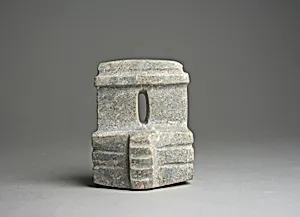
Architectural Model
Unknown Artist
1st–8th century
Medium
Stone
Dimensions
H. 3 1/4 × W. 2 3/4 in. (8.3 × 7 cm)
Classification
Stone-Sculpture
Culture
Mezcala
Department
Arts of Africa, Oceania, and the Americas
Museum
Metropolitan Museum of Art, New York, NY
Credit
Bequest of Arthur M. Bullowa, 1993
Accession Number
1994.35.694
Rights
Public Domain
Tags
Art Historical Context
This exquisite *Architectural Model* from Mezcala culture (1st–8th century offers a rare glimpse into ancient Mesoamerican architecture. Carved from stone and measuring just 3¼ × 2¾ inches (8.3 × 7 cm), this miniature sculpture likely represents a temple or ceremonial structure, evoking the stepped pyramids and ritual spaces central to Mezcala spiritual life in Guerrero, Mexico. The Mezcala people, flourishing during the Late Preclassic to Early Postclassic periods, crafted such models as votive offerings or symbolic representations of cosmic order and divine dwellings. Mezcala's stone sculptures are renowned for their compact scale and polished surfaces, achieved through meticulous carving and abrasion techniques using hard local stones like andesite or basalt. This piece exemplifies their abstract, geometric style—emphasizing form over naturalistic detail—to convey enduring cultural values of ancestry, fertility, and cosmology. Though the artist remains unknown, the model's precision reflects a sophisticated tradition of lapidary art. Now housed in the Metropolitan Museum of Art's Department of the Arts of Africa, Oceania, and the Americas (Bequest of Arthur M. Bullowa, 1993), it invites us to ponder how these tiny talismans bridged the earthly and divine in pre-Columbian societies. A testament to Mezcala's enduring legacy amid limited surviving artifacts.