
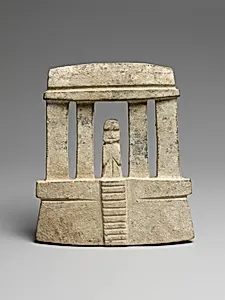
Architectural Model with Figure
Unknown Artist
1st–8th century
Medium
Stone
Dimensions
Height 6-1/2 in.
Classification
Stone-Sculpture
Culture
Mezcala
Department
Arts of Africa, Oceania, and the Americas
Museum
Metropolitan Museum of Art, New York, NY
Credit
Bequest of Arthur M. Bullowa, 1993
Accession Number
1994.35.629
Rights
Public Domain
Tags
Art Historical Context
This petite stone Architectural Model with Figure, standing just 6-1/2 inches tall, hails from the ancient Mezcala culture of Guerrero, Mexico, dating to 1st–8th century CE. Carved from durable stone, it exemplifies the Mezcala's mastery of compact, abstract sculpture, likely representing a temple or sacred structure adorned with a stylized human figure. Such models were portable treasures, possibly used in rituals, offerings, or as grave goods, evoking the spiritual architecture of pre-Columbian Mesoamerica. Mezcala artists employed meticulous techniques like pecking, grinding, and polishing to achieve smooth, minimalist forms that prioritize symbolic essence over realism. The inclusion of a figure—perhaps a deity, priest, or ancestor—suggests a narrative of devotion or cosmic order, linking the earthly temple to divine realms. These works bridge the Formative and Classic periods, offering rare glimpses into a culture known for its enigmatic greenstone carvings traded across regions. Today, this piece from the Metropolitan Museum of Art's Arts of Africa, Oceania, and the Americas collection invites us to ponder Mezcala's enduring legacy: a world where stone whispered stories of temples rising toward the heavens. (198 words)