
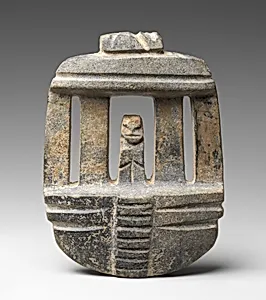
Architectural Model with Figures
Unknown Artist
200 BCE–500 CE
Medium
Greenstone
Dimensions
H. 5 5/8 × W. 4 1/8 × D. 1 in. (14.3 × 10.5 × 2.5 cm)
Classification
Stone-Sculpture
Culture
Mezcala
Department
Arts of Africa, Oceania, and the Americas
Museum
Metropolitan Museum of Art, New York, NY
Credit
Bequest of Arthur M. Bullowa, 1993
Accession Number
1994.35.633
Rights
Public Domain
Tags
Art Historical Context
This exquisite *Architectural Model with Figures*, crafted by an unknown Mezcala artist between 200 BCE and 500 CE, offers a rare glimpse into the sacred architecture of ancient Mesoamerica. Carved from smooth greenstone—a hard, precious material often prized for its jade-like green hue—the compact sculpture (just 5 5/8 inches tall) depicts a stylized temple structure adorned with diminutive human figures. Housed in the Metropolitan Museum of Art's Department of Arts of Africa, Oceania, and the Americas, it reflects the Mezcala culture of Guerrero, Mexico, known for such intricate stone carvings. Mezcala works like this one provide invaluable evidence of early religious practices, likely representing stepped temple platforms central to rituals and offerings. The abstract, elongated figures—possibly priests or deities—stand rigidly, evoking a sense of solemn ceremony. These models, often buried as votive objects, highlight the culture's sophisticated stoneworking amid the transition from formative to classic Mesoamerican periods. The artist's mastery of greenstone is evident in the precise carving and polished finish, achieved through abrasion and patience without metal tools. As a bequest from Arthur M. Bullowa in 1993, this piece connects us to a vibrant pre-Columbian world, where miniature art encapsulated profound spiritual beliefs.