
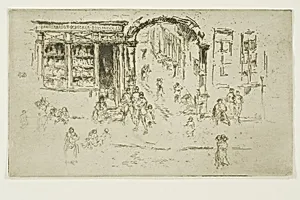
Archway, Brussels
Medium
Etching with foul biting in black ink on cream laid paper
Dimensions
Plate: 12.7 × 21.6 cm (5 × 8 9/16 in.); Sheet: 13 × 22.7 cm (5 1/8 × 8 15/16 in.)
Classification
etching
Department
Prints and Drawings
Museum
Art Institute of Chicago
Accession Number
29447
Rights
Public Domain
Art Historical Context
James McNeill Whistler’s *Archway, Brussels* (1887) invites visitors into the atmospheric streets of late 19th-century Belgium. Created during Whistler’s travels to Brussels, this etching captures a dramatic stone archway framing a glimpse of urban life, rendered with the artist’s signature subtlety and tonal harmony. Whistler, an American expatriate in London and a key figure in the Aesthetic movement, prioritized “art for art’s sake,” emphasizing mood and composition over narrative detail in his prints. The work exemplifies Whistler’s innovative etching technique, where acid selectively bites into a metal plate to create intricate lines and textures. Here, “foul biting”—unintended acid corrosion—adds a gritty, organic texture to the stone surfaces, enhancing the sense of age and shadow. Printed in black ink on cream laid paper (plate: 12.7 × 21.6 cm), it belongs to his acclaimed *Brussels Set*, a series of 12 etchings that revitalized printmaking by blending Realism with impressionistic effects. Housed in the Art Institute of Chicago’s Prints and Drawings department, *Archway, Brussels* showcases Whistler’s mastery of monochrome, influencing later artists like those in the Art Nouveau era. It’s a testament to how everyday architecture could evoke poetic mystery.
About the Artist
James McNeill Whistler · 1834–1903
James Abbott McNeill Whistler (1834-1903) was an American-born painter and printmaker who became a leading figure in the Aesthetic Movement and pioneer of Tonalism and Japonisme. He revolutionized art by championing "art for art's sake" and treating paintings as visual equivalents of musical compositions, titling works as "arrangements," "harmonies," and "nocturnes" to emphasize formal qualities o...