
Arguing Prostitutes
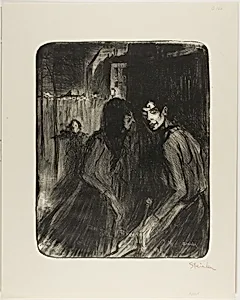
Medium
Lithograph in black on ivory laid paper
Dimensions
Image: 40.3 × 32.4 cm (15 7/8 × 12 13/16 in.); Sheet: 54.6 × 43.7 cm (21 1/2 × 17 1/4 in.)
Classification
lithograph
Department
Prints and Drawings
Museum
Art Institute of Chicago
Accession Number
133315
Rights
Public Domain
Art Historical Context
**Arguing Prostitutes** (1895) is a striking lithograph by Théophile-Alexandre Steinlen, a Swiss-born artist who captured the gritty underbelly of fin-de-siècle Paris. Printed in black ink on ivory laid paper, this work measures 40.3 × 32.4 cm and exemplifies Steinlen's mastery of social realism. He was a key figure in the Belle Époque poster art scene, often depicting working-class life, cabaret performers, and marginalized figures like prostitutes with unflinching empathy. Here, two women locked in heated debate embody the raw energy of Montmartre's streets, highlighting the artist's commitment to everyday human drama. Lithography, Steinlen's preferred medium, allowed for rich tonal gradations and fluid lines that mimic charcoal drawings, making fine art accessible through affordable prints. This technique boomed in late 19th-century France, fueling the poster revolution and artists like Toulouse-Lautrec. Steinlen's posters for the Chat Noir cabaret brought his style to the masses, blending Art Nouveau elegance with stark social commentary. Housed in the Art Institute of Chicago's Prints and Drawings Department, *Arguing Prostitutes* offers a window into urban poverty and female resilience during a time of rapid modernization. Its candid portrayal challenges romanticized views of Parisian nightlife, inviting viewers to reflect on the humanity behind the hustle. (198 words)
About the Artist
Théophile-Alexandre Pierre Steinlen · 1859–1923
Théophile Alexandre Steinlen, born on November 10, 1859, in Lausanne, Switzerland, grew up in an environment steeped in artistic influence, with his grandfather serving as a drawing teacher in nearby Vevey. He studied literature at the University of Lausanne before working as a designer trainee in a Mulhouse textile mill. In his early twenties, around 1881, Steinlen married Émilie Mey, and the cou...