
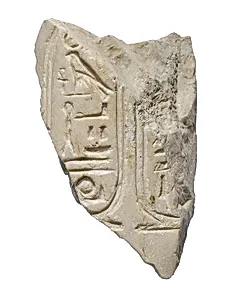
Arm at wrist, Aten cartouches
Unknown Artist
ca. 1353–1336 B.C.
Medium
Indurated limestone
Dimensions
9.5 x 7 x 2.5 cm; cartouche W. 2.6 cm
Classification
Arm at wrist, Aten cartouches
Period
New Kingdom, Amarna Period
Department
Egyptian Art
Museum
Metropolitan Museum of Art, New York, NY
Credit
Harris Brisbane Dick Fund, 1957
Accession Number
57.180.24
Rights
Public Domain
Art Historical Context
This delicate fragment, titled *Arm at Wrist, Aten Cartouches*, hails from Egypt's Amarna Period (ca. 1353–1336 B.C.), a era in the New Kingdom Dynasty 18. Carved from indurated—a durable, hardened stone prized for its fine grain and ability to hold intricate details—this 9.5 cm piece depicts a wrist section adorned with the royal cartouches of Aten, the sun disk deity. These oval inscriptions, each 2.6 cm wide, protected the god's name in hieroglyphs, a convention in Egyptian art symbolizing eternity and divine authority. The Amarna Period, under Pharaoh Akhenaten, marked a bold shift toward monotheism, elevating Aten above traditional gods and inspiring naturalistic, elongated forms in sculpture. Though the artist remains unknown, the precise carving exemplifies the era's hieroglyphic mastery, where every stroke conveyed cosmic power. Likely part of a larger statue or relief from Akhenaten's capital at Amarna, this wrist fragment offers a tactile glimpse into a transformative religious revolution. Acquired through the Harris Brisbane Dick Fund in 1957, it now resides in the Metropolitan Museum of Art's Egyptian Art collection. For visitors, it whispers of ancient devotion—imagine the sun's rays illuminating these cartouches in a temple glow, bridging us to a pharaoh's daring vision.