
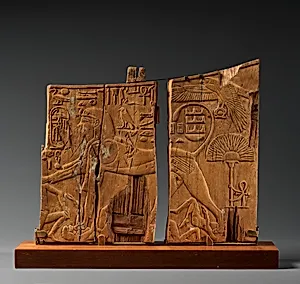
Arm Panel From a Ceremonial Chair of Thutmose IV
Unknown Artist
ca. 1400–1390 B.C.
Medium
Wood (ficus sycomorus?)
Dimensions
H. 26 × W. 30 × Th. 2.2 cm (10 1/4 × 11 13/16 × 7/8 in.)
Classification
Chair, Arm Panel
Period
New Kingdom
Department
Egyptian Art
Museum
Metropolitan Museum of Art, New York, NY
Credit
Theodore M. Davis Collection, Bequest of Theodore M. Davis, 1915
Accession Number
30.8.45a–c
Rights
Public Domain
Tags
Art Historical Context
This arm panel once formed part of a ceremonial chair belonging to Pharaoh Thutmose IV, who ruled Egypt during the height of the New Kingdom’s Eighteenth Dynasty around 1400–1390 B.C. Crafted from fine-grained wood, possibly sycamore fig, the small yet exquisitely carved fragment would have rested at the side of the royal throne, its surface alive with symbols of divine kingship. Falcons, hieroglyphs, and a sphinx—motifs traditionally associated with the god Horus and the pharaoh’s protective power—remind viewers that every object surrounding the ruler reinforced his sacred authority. New Kingdom artisans achieved remarkable precision in low-relief carving, allowing delicate details to emerge even on a panel only 2.2 centimeters thick. The presence of these protective emblems suggests the chair was not merely furniture but a portable statement of cosmic order, used in processions and court ceremonies. Today the fragment survives in the Metropolitan Museum of Art thanks to the 1915 bequest of Theodore M. Davis, offering modern visitors a rare glimpse into the intimate luxury that surrounded one of Egypt’s most celebrated warrior-kings.