
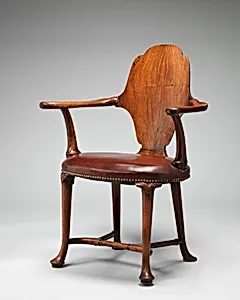
Armchair
Unknown Artist
ca. 1710
Medium
Walnut; oak and walnut veneer
Dimensions
Overall: 36 1/2 × 22 1/2 × 16 1/2 in. (92.7 × 57.2 × 41.9 cm)
Classification
Woodwork-Furniture
Culture
British
Department
European Sculpture and Decorative Arts
Museum
Metropolitan Museum of Art, New York, NY
Credit
Gift of Irwin Untermyer, 1964
Accession Number
64.101.919
Rights
Public Domain
Art Historical Context
This elegant armchair, crafted around 1710 in Britain, the refined furniture of the early 18th century, a time when walnut became the wood of choice for its rich grain and lustrous finish. Made primarily of walnut with oak and walnut veneer, it showcases veneering techniques—thin sheets of decorative wood glued to a sturdy core—that allowed artisans to create intricate patterns and enhance durability while highlighting the wood's natural beauty. Standing at 36½ inches tall, its proportions reflect the shift toward comfortable, domestically oriented seating in British homes during the Queen Anne era. As a piece of woodwork from the European decorative arts tradition, this armchair held cultural significance as a marker of social status. Wealthy households displayed such finely crafted furniture in parlors and drawing rooms, blending functionality with subtle ornamentation. Its unknown maker underscores the collaborative craft of period workshops, where skilled joiners and veneers worked anonymously for elite patrons. Today, gifted to the Metropolitan Museum of Art by Irwin Untermyer in 1964, it invites us to appreciate the artistry of everyday luxury from Britain's golden age of cabinetmaking. (198 words)