
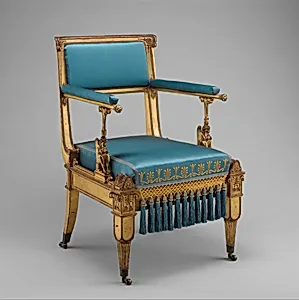
Armchair
Medium
Gilded mountain ash; brass mounts and casters; modern upholstery
Dimensions
Overall: 35 1/2 × 24 1/4 × 23 1/4 in. (90.2 × 61.6 × 59.1 cm)
Classification
Woodwork-Furniture
Culture
German, Berlin
Department
European Sculpture and Decorative Arts
Museum
Metropolitan Museum of Art, New York, NY
Credit
Purchase, Gifts of Mr. and Mrs. William Randolph Hearst Jr., Irwin Untermyer, and John D. Rockefeller Jr., by exchange, and Bequest of John L. Cadwalader, by exchange, 1996
Accession Number
1996.30
Rights
Public Domain
Art Historical Context
This elegant armchair, crafted around 1828 in Berlin, represents a pinnacle of German neoclassical design under the direction of architect Karl Friedrich Schinkel, in collaboration with cabinetmakers Johann Christian Sewining Karl Wanschaff. Schinkel, a leading figure in Prussian architecture and interiors, often oversaw furniture production for royal palaces and elite residences, blending classical proportions with functional luxury. Dating to the Biedermeier era—a period of refined domesticity in early 19th-century Germany piece exemplifies Berlin's furniture workshops, where innovation met imperial patronage. Fashioned from gilded mountain ash—a durable, light wood enhanced with gold leaf for a shimmering opulence— the chair features ornate brass mounts and casters for smooth mobility and added grandeur. Its modern upholstery preserves the original form while adapting to contemporary tastes. At 35½ × 24¼ × 23¼ inches, the armchair's compact scale suits intimate salon settings, highlighting meticulous joinery and symmetrical lines that evoke ancient Greek and Roman precedents. Now housed in the Metropolitan Museum of Art's European Sculpture and Decorative Arts department, this armchair underscores Berlin's role as a hub of neoclassical craftsmanship. Acquired through prestigious gifts and exchanges in 1996, it invites visitors to appreciate how everyday objects embodied the era's cultural aspirations for harmony, elegance, and enduring beauty.
About the Artist
Karl Friedrich Schinkel|Johann Christian Sewining|Karl Wanschaff · 1781–1841
German architect.