
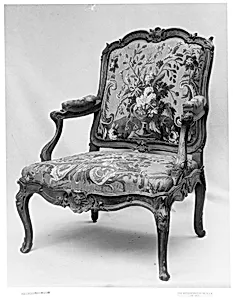
Armchair (Fauteuil)
1700–1735
Medium
Carved walnut; Aubusson tapestry upholstery
Dimensions
Overall: 46 1/2 × 26 1/2 × 22 in. (118.1 × 67.3 × 55.9 cm)
Classification
Woodwork-Furniture
Culture
French
Department
European Sculpture and Decorative Arts
Museum
Metropolitan Museum of Art, New York, NY
Credit
Gift of J. Pierpont Morgan, 1906
Accession Number
07.225.43
Rights
Public Domain
Art Historical Context
This elegant armchair, or fauteuil, was created in France during the early decades of the 18th century, a time when furniture design transitioned from the formal grandeur of the Louis XIV era toward the lighter, more playful aesthetics that would define the Rococo period. Crafted from carved walnut and upholstered with luxurious Aubusson tapestry, the piece reflects the refined tastes of French aristocratic interiors, where comfort and visual richness were equally prized. Aubusson, a historic center of tapestry weaving in central France, produced some of the finest textiles of the period. These woven panels often featured delicate floral motifs and pastoral scenes, bringing color, texture, and narrative interest to functional objects. The integration of such tapestries with sculptural walnut frames highlights the collaborative nature of French decorative arts, in which woodworkers, upholsterers, and weavers worked together to create harmonious ensembles for salons and drawing rooms. Acquired by the Metropolitan Museum of Art through the generosity of J. Pierpont Morgan in 1906, this fauteuil offers visitors a tangible connection to the daily life and artistic sophistication of early 18th-century France. Its sturdy yet graceful proportions speak to both the technical mastery of its makers and the enduring appeal of well-crafted seating furniture.