
Armet
Unknown Artist
ca. 1510–15
Medium
Steel
Dimensions
H. 11 3/4 in. (29.8 cm); W. 8 1/4 in. (21 cm); D. 12 7/8 in. (32.7 cm); Wt. 9 lb. 9 oz. (4350 g)
Classification
Helmets
Culture
possibly British or Flemish
Department
Arms and Armor
Museum
Metropolitan Museum of Art, New York, NY
Credit
Gift of William H. Riggs, 1913
Accession Number
14.25.584
Rights
Public Domain
Art Historical Context
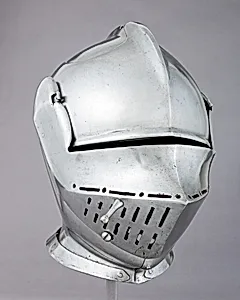
Step into the world of Renaissance warfare with this striking *Armet*, a steel helmet crafted around 1510–15 by an unknown artist, possibly from Britain or Flanders. Dating to the early 16th century, this helmet exemplifies the peak of European plate armor design, when master armorers balanced formidable protection with surprising mobility. Armets like this were favored by knights and men-at-arms for both battlefield combat and tournaments, offering full head and neck coverage while allowing clear vision and breathability. Measuring 11¾ inches high, 8¼ inches wide, and 12⅞ inches deep, with a hefty weight of over 9 pounds, the *Armet* highlights the engineering prowess of its era. Its form typically features a rounded skull, a pivoting visor, and a hinged bevor plate that locked securely around the throat—innovations that made it lighter and more versatile than earlier Gothic helms. Forged from high-quality steel, it would have been meticulously shaped, polished, and likely etched or gilded for a knight's display. Housed in the Metropolitan Museum of Art's Arms and Armor Department, this piece was a generous gift from William H. Riggs in 1913. It invites us to ponder the chivalric age, where such armor symbolized both martial might and artisanal excellence, bridging medieval traditions with the Renaissance's refined aesthetics.